
This story is part of Neighborhood Navigators, a social media first video series from Illinois Latino News that turns community research into stories about real solutions, told by the people already building them. In this first episode, we look at Belmont Cragin’s small business owners.
The Challenge
Why economy? The decision comes from the data. In a survey of more than 700 people across Illinois, all five social determinants of health we asked about were rated important, but economy ranked as the topic people were most dissatisfied with in the news coverage they get. That is why Neighborhood Navigators is focusing on economic issues for its next episodes, starting with Belmont Cragin’s small business owners.
Belmont Cragin is one of Chicago’s largest Latino neighborhoods, and small businesses line its main corridors. But behind that visible activity, many owners are stuck. They have working businesses and real customers, and they still can’t grow.
For Neighborhood Navigators‘ first episode, our team spent weeks conducting empathy interviews with residents and small business owners in Belmont Cragin to understand what “economic issues” actually means to them, in their own words. A pattern emerged quickly: this wasn’t a story about whether people were willing to work hard. Nearly everyone we spoke with described working constantly, often at more than one job, with little to show for it. The barrier wasn’t effort. It was access.
That access gap showed up in different forms. One business owner told us she lost her ability to qualify for a loan when lenders stopped accepting ITIN numbers, blocking her from financing to grow a business that was already working. She’d also spent years searching for affordable commercial space, priced out by high rents in the neighborhood. Other business owners described property and business taxes eating up nearly all their profit, even after years in business. But running underneath nearly every conversation was something more basic: language.
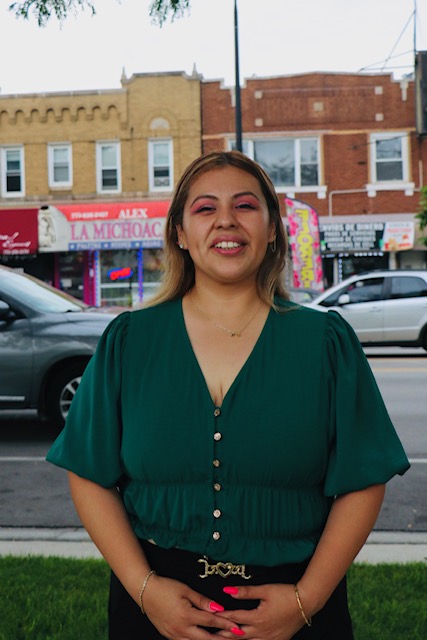
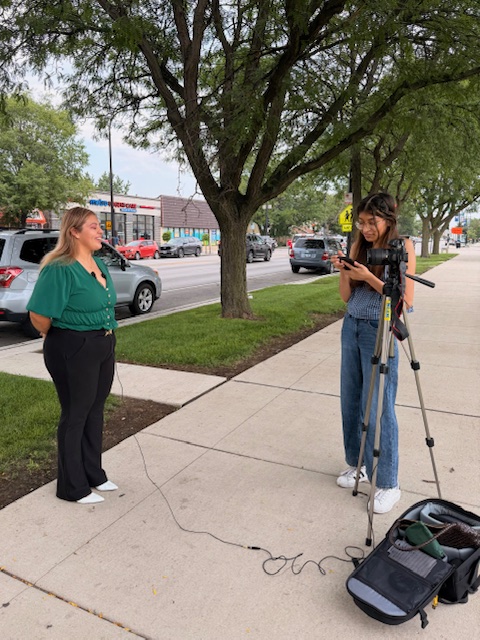
Roxana Brito has seen that barrier up close. She’s a Corridor Ambassador with Northwest Side CDC‘s Belmont Corps of Ambassadors team, embedded directly in the neighborhood’s business corridors along Fullerton, Diversey, Belmont, and Grand Avenue. “So many times they do want to learn or educate themselves,” she said of the business owners she works with, “but there’s always that language barrier where a lot of things are not offered to them in Spanish.” Even when help exists, she added, the workshops and events are often held outside Belmont Cragin, adding a transportation barrier on top of everything else.
The Response
Northwest Side CDC’s answer isn’t a hotline or a form. It’s people. Roxana’s team works block by block, building relationships with business owners over time, in Spanish, in person. “It’s not somebody just behind the desk,” she said, “but someone that’s actually getting to know them” — meeting people where they are, both geographically and in terms of what they already know.
That relationship-first model has produced concrete outcomes. Roxana described one business owner with a strong product who lacked mentorship and guidance; her team helped connect him to more affordable, accessible locations, and later walked him through applying for loans and grants, without his language barrier standing in the way at each step. CRECER, the incubator program that grew out of this same approach, walks small business owners through shared workspace with the eventual goal of securing their own storefront; a coffee shop that came out of the program is now a fixture in the neighborhood.
Northwest Side CDC tracks whether this model works. Business advisors log which workshops are held, how many people attend, and whether programs are translating into real growth. The coffee shop success story became compelling enough evidence that the organization is now expanding the incubator model, through a project with the city, into Belmont Cragin’s Central Corridor.
The digital-literacy story is a useful test case because the odds were stacked against it. One business owner Roxana worked with didn’t just face a language barrier; he’d also lost a business partner over immigration-related complications, forcing him to restructure as a sole proprietorship while learning digital skills from scratch. Starting with basic computer classes, he went on to build his own website, set up social media, and create his own promotional videos. If the model can work when several barriers compound at once, it can work elsewhere.
Roxana is candid about where the current approach falls short. It works best for business owners who are already established in the neighborhood; newcomers who don’t yet know the community, its culture, or where to find help are harder to reach. And underneath the language barrier sits a funding barrier: Belmont Cragin, she said, remains underfunded relative to nearby areas that have received more investment, even though the need is comparable or greater.
That gap points to what’s still missing. As Roxana put it, the biggest unsolved piece of the puzzle isn’t a single program; it’s an ongoing need for advocacy: continuing to be “a voice for our small business entrepreneurs,” and continuing to push for the funding and representation that would let existing solutions reach further than they currently do.
Neighborhood Navigators was launched with support from the Field Foundation, whose investment is helping Illinois Latino News expand community-powered, solutions-focused journalism.