
CHICAGO— Chicago’s first environmental justice ordinance sits dormant in the City Council’s Zoning Committee. Awaiting further action, some activists and alders have been pushing to get it passed, while others don’t want it passed at all.
At a Nov. 3 rare special committee meeting, Ald. Bennett Lawson (44th Ward), chair of the City Council’s Zoning Committee, said he would not call for a vote on the ordinance. His decision signaled the measure may lack enough support to advance, but its sponsors think there is enough community support to push it forward.
Named after a Southeast Side environmentalist who pioneered activism in the city’s industrial neighborhoods decades ago, the Hazel Johnson Cumulative Impacts Ordinance would counteract the industrial zoning that occurs in industrial corridors, where Black and brown communities disproportionately reside. It would place additional restrictions on companies from exposing these communities to toxic air, water and soil, establish an environmental justice project manager and advisory board, create additional relocation requirements for companies and force the city to more carefully consider how industrial entities will affect communities.
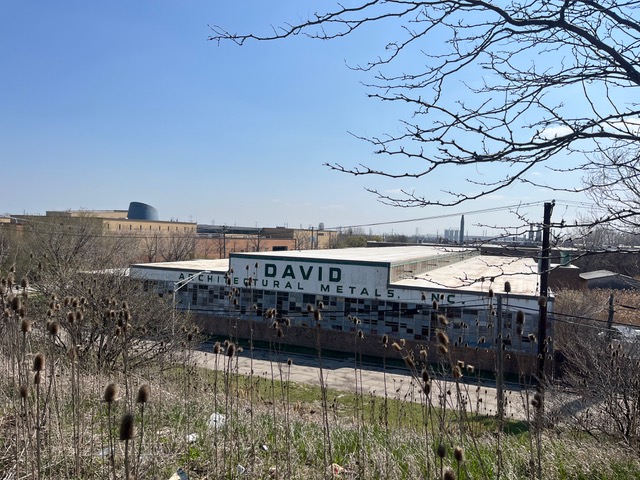
The measure would protect a number of neighborhoods in the industrial corridor along the South Branch of the Chicago River, such as Little Village, Pilsen and Stevenson, from future pollution and health risks. It would also shield the Southeast Side along the Calumet River.
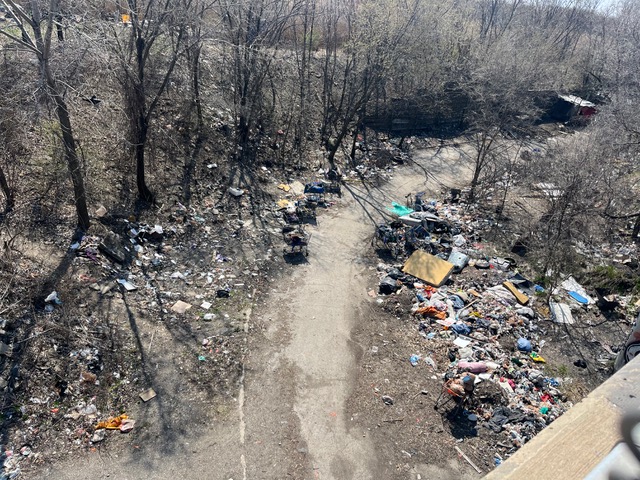
Next to 31st Street, which borders the industrial zone, piles of trash have accumulated beneath the elevated road. / Ruby Grisin
“The only way more alders are going to act on it is if they hear from their constituents,” said John Cruz Barcenas, deputy chief of staff for Ald. Rossana Rodriguez Sanchez (33rd Ward), who is the ordinance sponsor.
He added that, while the last few months were “dominated by the city budget fight,” he is hopeful the conversation will gain momentum again in the new year, as the need for the measure has not diminished.
“I know people are literally working every day on this. So yeah, there’s a lot behind this. I always think the will of the people will win out,” he continued.
The City Council formally introduced the ordinance in April after HUD reached an agreement with the city of Chicago. The Hazel Johnson Cumulative Impacts Ordinance received support from sponsors, Mayor Brandon Johnson and five alderpeople, including Ald. Julia Ramirez (12th Ward), Ald. Daniel La Spata (1st Ward) and Ald. Byron Sigcho-Lopez (25th Ward).
Originally born to settle an investigation by the Chicago Department of Housing and Urban Development (HUD) into the unequal distribution of industrial sites in Chicago, the ordinance was part of an environmental justice action plan that aimed to assess and mitigate environmental racism in the city. The measure has since lost HUD accountability after the Trump administration dismissed HUD’s role in this and several cases in other cities, according to ProPublica.
“Chicago has a long history as an industrial hub, but that industry has at times come at a cost to working-class Chicagoans,” Johnson said in a press release, defending the ordinance. “Economic development cannot be a tradeoff where we sacrifice the health of Black and brown communities.”
How the ordinance began
In 2018, some Chicago environmental groups learned that General Iron—a former scrap metal shredder business situated on the North Branch of the Chicago River in affluent Lincoln Park— obtained a preliminary city permit to relocate to East 116th Street along the Calumet River. Metal shredders are known to release air pollutants, according to the EPA, and environmental groups were already concerned about preexisting toxins in neighborhoods along the industrial corridor on the Southeast Side, which the U.S. Environmental Protection Agency (EPA) planned to excavate, said Gina Ramirez, senior advisor at Southeast Environmental Task Force, who helped develop the HUD civil rights complaint that triggered the ordinance’s creation.
All these factors began to compound. Three organizations: the Southeast Environmental Task Force, South East Side Coalition to Ban Petcoke and People for Community Recovery, joined together in an effort to advocate for housing justice in Chicago.
“That’s when we filed the HUD complaint against the city of Chicago and against the state, because this was a clear example of environmental racism,” said Gina Ramirez. “There wasn’t community input taken into consideration. The way the permitting process was—and still is—is very dysfunctional.”
In October 2020, the three environmental organizations issued a civil rights complaint to HUD in hopes of preventing a city permit from being handed out so easily. Then, HUD began its assessment.
After almost three years, General Iron was denied the final city permit to relocate. The decision was upheld by a Cook County Circuit Court Judge in August 2024, which was considered a victory for Chicago environmental groups.
A year later, the city settled with HUD and the Illinois EPA, which Gina Ramirez said was historic. HUD threatened the City of Chicago with the loss of more than $350 million in federal block grants unless the city developed an agreement and measure to achieve environmental justice. The city’s plan would protect historically-polluted neighborhoods through new government positions and more rigorous zoning laws.
Now, the Trump administration moved to drop further HUD action on the civil rights ruling, according to Cruz-Barcenas.
“Unfortunately, like a lot of things, this new [federal] administration has just thrown a wrench into a lot of things that we are seeing good work being done on,” he said. “This is just [an] all the more stronger argument that if we don’t pass this on a city level, then no one’s going to do it. So this should really be a motivating factor for City Council to take this a lot more seriously, knowing that we don’t have HUD.”
HUD declined to comment to Illinois Latino News on the new ordinance, directing further questions to the EPA.
On a federal level, the Trump administration has been fighting against the landmark Fair Housing Act of 1968, which prohibits housing discrimination on the basis of various factors, such as gender and race, which was part of the basis for the initial HUD complaint. The Alliance for Housing Justice expressed deep concern regarding Trump’s “Disparate Impact Executive Order,” in particular, which deemphasized liability for when particular groups face increased environmental impacts despite a neutral policy.
Patterns of Pollution
About three years after Tanisha Rae, a founding member of Neighbors for Environmental Justice (N4EJ), bought her McKinley Park home in 2015, she began to notice pungent smells she suspected came from the newly established MAT Asphalt plant on 2033 W. Pershing Road. No one had informed her about this potential polluter prior to purchasing the house.
“It was so bad that I would be sleeping in the early morning hours and wake up because the odors were so strong, and they were penetrating inside my home without the windows open,” explained Rae. “There was nothing that I could do except put a pillow over my head.”
Since their opening in 2018, Rae has submitted multiple complaints to CHI 311 and has called MAT a total of five times. The plant returned her calls twice, but she has not had the chance to respond.
Living in McKinley park, Rae noted that layers of black film continued to reappear on her car and windows, despite cleaning them regularly. Since she was a child, Rae has been facing environmental racism, she said. Still, she did not notice it until later in life.
“The reservation I’m from, which is Bad River Indian Reservation in northern Wisconsin, you couldn’t drink the water there,” Rae said. “And now that I’m an adult, I own my own home, and now I can’t breathe the air.”
According to complaints obtained by N4EJ through an open records request to the Illinois EPA in 2019, several residents had been noticing a strong smell, attributing it to MAT Asphalt.
One resident observed gas plumes of 100% opacity in May 2019, though the city’s emission standard is only 20%. MAT Asphalt continues to state on its website that it is complying with all requirements and exceeds the standard of protection for its neighbors. The company did not respond to a request for comment by the time of publication.
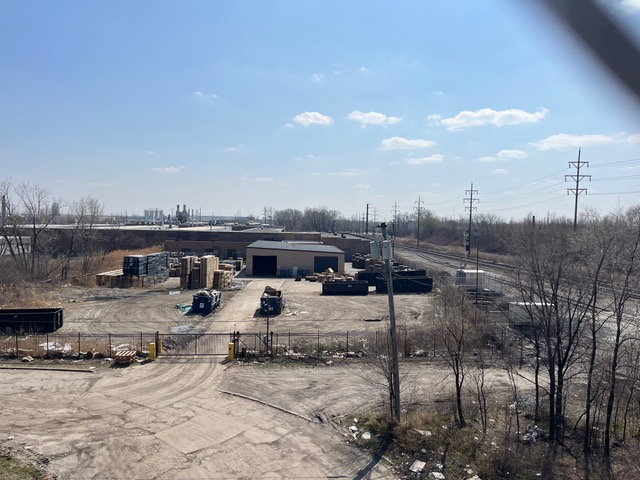
A large plot of land in Little Village bordering Piotrowski Park anda local high school, containing a Target warehouse, and the site of the Crawford Generating Station; a coal-fired power plant. Now partially collapsed, it is surrounded by train tracks and fences, the area is off-limits for the public. / Ruby Grisin
“We went beyond what is required to construct and operate a facility that contributes to the City of Chicago’s infrastructure and economic development needs—without affecting the quality of life or health of local residents, or posing harm to the local environment,” reads a statement on its website about their commitment to environmental safety.
Just across the river, residents of Little Village experienced a similar scenario. A shuttered coal plant implosion in 2020 destroyed a final smoke stack at the former Crawford coal-fired power plant and sent a cloud of heavy dust across the neighborhood. The plant shuttered in 2012 after the imploding stack sparked uproar from residents and a class action lawsuit.
The new developer, Hilco Redevelopment Partners, transformed it into a new Target warehouse and distribution center in 2021.
The warehouse has since become a cause for concern because residents have noticed an increase in truck traffic through the residential neighborhood, allegedly worsening air quality. President of the Little Village Community Council Baltazar Enriquez said asthma and other pulmonary issues are becoming a large problem in Little Village.
He added that there is a severe lack of pulmonary doctors in the area, making it difficult for people to receive the care they need.
Enriquez expressed distrust in the plants and warehouses themselves, in addition to the government officials overseeing those companies, due to longstanding inequities in environmental exposure.
Peoples Gas, a natural gas utility serving the city of Chicago, said that in 2020 they knocked down their separate warehouse building at 4358 W. 35th Place. Enriquez said he did not feel properly informed about what they wanted to do with this land once it became vacant. He recalled a public meeting at Piotrowski Park in Little Village where a representative did not directly answer a question about it.
Peoples Gas completed remediation at two parcels located at 4358 W. 35th Place between 2020 and 2022 under the oversight of the U.S. EPA.
“In late January 2025, Peoples Gas completed in situ stabilization (ISS) treatment activities at Parcels “A” and “B” of the Crawford Station former manufactured gas plant, or MGP, site located at 4543 West 35th Street and 3600 South Kostner Avenue in Chicago, Illinois,” according to the EPA website.
Regarding this property, David Schwartz, a spokesperson for Peoples Gas, said, “Representatives from the local community, Little Village Environmental Justice Organization (LVEJO) and the local alderman’s office, were kept up to date throughout the process about plans for taking down the warehouse.”
Schwartz said that the site is now being leased to a shipping and logistics company and communication with residents is a priority for Peoples Gas.
Divisions over the Hazel Johnson Ordinance
Some community members along the industrial corridor do not want the ordinance to pass as is. Enriquez said the Little Village Community Council has been fighting to “give the ordinance some teeth.” He said the measure would be ineffective unless legislators adjust it to regulate existing chemical plants, in addition to new and relocating ones. How it stands now, the ordinance would only protect entities proposing relocation, rather than preexisting polluters.
Enriquez suggested the ordinance change the physical zoning in the city, rather than implementing additional barriers within the existing process, and impose fines on big polluters in environmental justice neighborhoods. His critiques to alderpeople have “gone on deaf ears.”
Theresa McNamara, chairperson of the Southwest Environmental Alliance, said the ordinance does not do enough to represent the impact of Hazel Johnson’s legacy and protect neighborhoods of primarily Black and brown communities. She said she hopes it does not pass.
McNamara and Enriquez both said they did not feel they were given fair opportunity to raise their concerns about the ordinance. Instead, McNamara said he believes the bill sponsors prioritized the approval of city-funded organizations.
“This ordinance is just a first step. It’s not the last piece of environmental legislation,” Cruz-Barcenas said. “We’re going to push forward, we’re going to pass this and then we’re going to take it from there, and then keep on going until all of our environmental justice neighborhoods see change.”
Ruby Grisin is a senior at Northwestern University majoring in Journalism and Environmental Policy, currently reporting for elDiarioAR in Buenos Aires, Argentina.
Cover Photo: David Architectural Metals, Inc. is a longtime Chicago metal fabrication company for commercial and industrial construction. The company is situated in the same area as the other sites.