
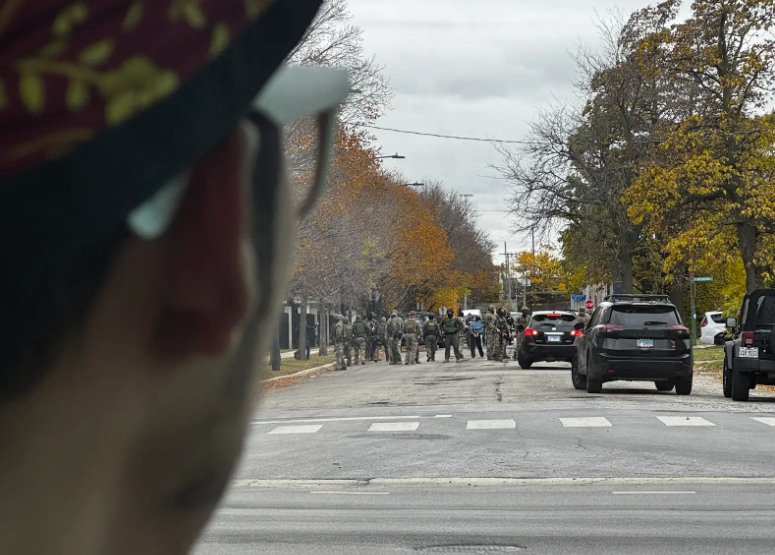
The flickering of emergency lights, waves of heat, and a white paper cup of hot chocolate in the cupholder combated the 46-degree weather. It was a gloomy Saturday morning in Pilsen, and William Guerrero, then 24, was ready to start his day with Daisy, a tan Honda Odyssey van.
The vehicle had recently been tuned up, and Guerrero was eager to drive it around town.
As he passed the CTA Pink Line 18th Street station that morning, he learned that Immigration and Customs Enforcement was in the Little Village neighborhood detaining an individual.
Flashes from his phone due to increased WhatsApp group notifications and the squeal of new brake pads heightened Guerrero’s anxiety. There was ICE activity in the area. Before driving to the neighboring community, Guerrero checked on local street vendors located at the intersection of West 21st Street and South Damen Avenue.
“I don’t want to let my guard down,” he said while driving by the well-populated location. “Usually, if there’s a sighting in Pilsen, I leave Little Village and come straight here.”
Guerrero — known on social media as “The KiD From Pilsen” — began patrolling Pilsen and Little Village in early October when ICE presence drastically increased in Chicago. A Pilsen native who relied on side hustles at the time, Guerrero founded the Chicago Chess Club, an open community-building organization that has a “Latino twist,” towards the end of 2024 and became the youngest person to run for a Chicago Police District Council seat in February 2023.
Now, he tries to patrol every day to keep community members safe and informed. On Saturday, Nov. 8, at 9:37 a.m., Guerrero began his watch on the Lower West Side.
The 24-year-old’s contribution is more than just community surveillance; it’s an act of protest that contributes to a lasting legacy of resistance the local Mexican community has developed for decades. In the age of mass deportation in the United States, individuals like Guerrero are ensuring that those committing or supporting discriminatory practices are held accountable.
Once Guerrero saw that the vendors were safe, he made his way towards “La Villita” to witness the active detainment. In preparation for alerting locals about the incident, Guerrero blew an orange whistle, which hung around his neck, as Daisy approached the Little Village Arch.
“Wait, they’re right there,” Guerrero frantically said before parking the van and running toward a crowd of Chicago Police Department officers, U.S. Border Patrol agents and onlookers in front of Chicago’s oldest taqueria, Los Comales.
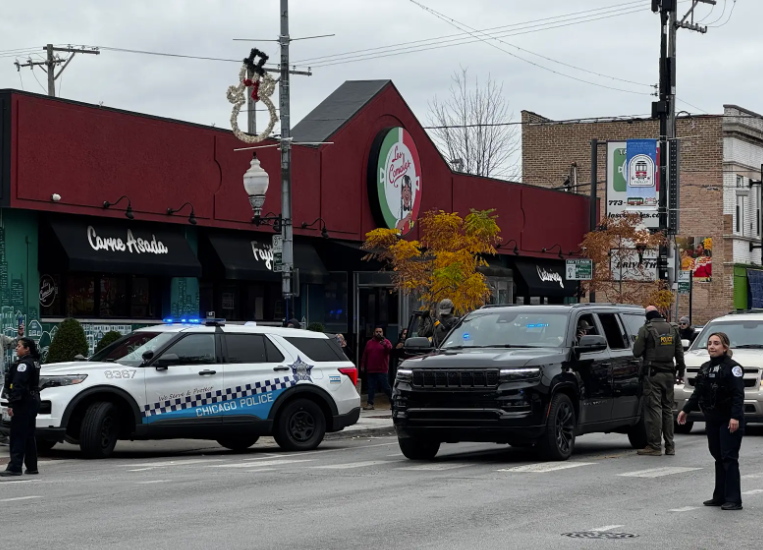
Two men began recording and documenting confrontations with CPD while swearing at masked officers who rode in SUVs. Notably, former Border Patrol commander-at-large Gregory Bovino was present at the sight, riding inside a tan Chevrolet Tahoe without license plates.
As the caravan of approximately 12 vehicles began to head to the Chicago hub of the Federal Bureau of Investigation, one of the men, wearing a dark-colored puffer, caused Bovino’s vehicle to make a harsh stop. Immediately, agents, including Bovino, arrested the other man in a brown jacket while the other person fled the scene.
A larger crowd amassed throughout West 26th Street, and federal agents, alongside local police, were met with anger, sadness and dismay. Whistles, screaming and chanting followed suit as the caravan made its way out of Little Village.
“Look, there they are. There’s all of them. Sons of b–ches,” said a man in Spanish while recording a video on his phone. “Sons of their b–ch mothers. F–king dogs!”
An enduring tradition
This trend of protest as an act of resistance isn’t new to Mexican communities present in Chicago, and Guerrero is one of many figures continuing the community activist tradition. In many events, the Mexican community in the city has utilized protest as an act of resistance against oppression.
The three-decade-long Chicano movement, a March 2006 immigrant rights march with over 100,000 demonstrators and thousands of marchers protesting the controversial 2010 Arizona SB 1070 Immigration Law, is essential to the enduring legacy.
According to the 2024 U.S. Census Bureau, an estimated 597,415 immigrants make up approximately 22% of Chicago’s population. The number of Chicagoans born outside the country is the highest in the city since 2006.
When President Donald Trump commenced his second presidential term in January 2025, he promised that mass deportation would be a priority of the administration. From ending birthright citizenship for children of undocumented immigrants to targeting cities offering “safe harbor to criminal illegal immigrants,” the Trump administration has and continues to implement measures that have significant impacts on vulnerable communities.
On Sept. 8, 2024, the Department of Homeland Security announced that ICE would begin Operation Midway Blitz, a surge involving multiple agencies targeting “Criminal Illegal Aliens Terrorizing Americans in Sanctuary Illinois.” Ever since then, local and national media outlets alike have put the spotlight on Chicago and the surrounding areas as locals fight back against federal action.
Community members, like Guerrero, not only contribute to the effort to protect one another, but they are also building a new generation of community activists and organizers crucial to preserving culture, unity and diversity amongst underserved areas.
The journey to preserve lasting legacies
Liliana Macias, cultural worker, educator and Ph.D. student at the University of Illinois Chicago, has analyzed the resilience of the Mexican community in Chicago in their research. Ever since their arrival from Jalisco, Mexico at the age of six, Macias found community in both Back of the Yards and Brighton Park neighborhoods.
As their family settled into Chicago, Macias felt right at home thanks to Mexican immigrants who moved to the city for better opportunities. The tightness of community members, especially at grocery stores and community centers, inspired Macias immensely.
“I felt like I was in Mexico, to be honest, surrounded by family, friends and people who knew how to get things done with nothing,” the academic proudly said. “I feel like that transition to me was almost seamless.”
When Macias’ parents went to church, they began to notice that the space became an opportunity to inform community members about pressing topics through labor organizing and women’s engagement.
A literature admirer, Macias often read books such as Gabriel García Márquez’s “One Hundred Years of Solitude” and grew interested in movements in Latin America and the Caribbean. Upon self-reflection, they began to question Chicago’s role in the context of oral history.
“I would spend my summers purposely trying to find, read and learn. I just fell in love with history,” they said. “Books (were) such an inspiration, but also just thinking ‘What about here?’ “What about where I live?’ (and) ‘Amazing folks must exist here’ set me on my path.”
In October 2023, they worked with four other women on the Pilsen Latina Legacies teach-in series, which is a part of the Chicago Monuments Projects. A few months later, Macias co-founded Raices Chicago Story Coalition, a non-profit organization that supports archival and storytelling-based projects by and for the Latino community.
With a focus on reevaluating how communities preserve and tell their own histories, Macias has talked to queer Latinas about their lasting legacies for their dissertation. From sorting out items that provide context to reflecting on historical harms and struggles, Macias says they feel healed.
Macias notes that the Trump administration recognizes that Chicago is a “Mexican metropolis,” which made the city a primary target in mass deportations. The educator hopes that “the systems of the city learn to love the people who make it as much as the people who build it.”
“These policies and executive orders (passed by Mayor Brandon Johnson in early October 2025) that are rolling out on (a) day-to-day basis to protect people from ICE (are) f–king beautiful,” Macias concluded while holding back tears of sadness. “I want a Chicago with all of these people because all of these people (are) what makes the city what it is.”
‘Get the f–k out’
Ever since his election in May 2019, Ald. Byron Sigcho-Lopez (25th) has become an outspoken advocate for community members in Pilsen, Little Village and University Village. As an Ecuadorian immigrant, Sigcho-Lopez has joined protests, demonstrations and sites of Border Patrol presence.
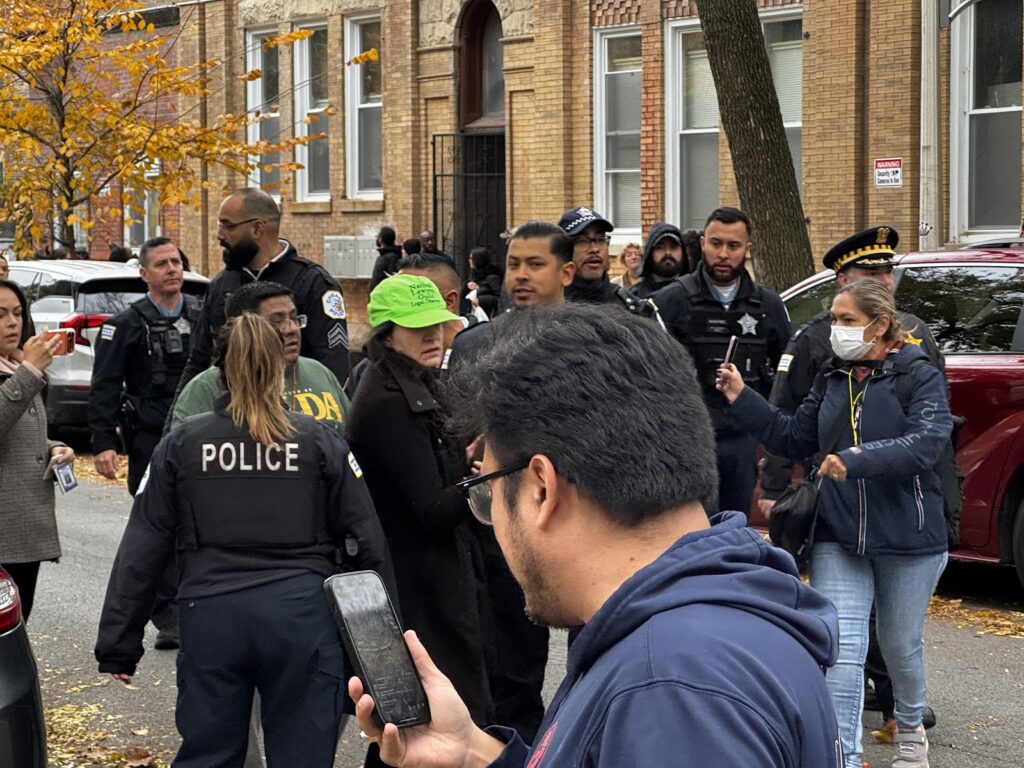
Around 12 p.m. on Nov. 8, 2025, Cicero’s West 23rd Street and South Sawyer Avenue was infiltrated with ICE and CPD presence. While masked federal agents surrounded a red brick apartment building, a red-headed woman protected an 11-year-old girl, who was about to be taken for questioning by ICE, according to the neighbor.
“Get the f–k out,” Sigcho-Lopez shouted repeatedly at ICE agents as they left the scene. “We’ll see you in court next week, you f–ks.”
Due to community efforts in preventing the incident from escalating further, the minor was not taken by ICE. The crowd moved up north, with Sigcho-Lopez, Guerrero, residents and CPD officers in a standoff.
As the crowd chanted “shame,” a confrontation broke out and batons were drawn by CPD officials. The alderman told officials that ICE was trying to “take a child.” According to Sigcho-Lopez, who spoke with the woman, the 11-year-old was with her father in a moving vehicle before ICE agents followed them around and shot at them.
The father fled the scene and the neighbor stepped in to ensure the minor was safe, the alderman said. According to the neighbor, the father and daughter are legal U.S citizens.
“Thank you for protecting that child from these f–king Nazis,” the alderman said to members present. “ICE is still in the neighborhood. This family is safe, (we) just got to keep on protecting each other. Shame on CPD.”
With the rise of ICE presence in communities such as Little Village, Sigcho-Lopez’s office has distributed Know Your Rights & Family Planning information while working with Pilsen’s Rapid Response Team (Puño) and non-profit organization Pilsen Defense & Access. The alderman said ICE raids have negatively impacted the economic development of street vendors and small businesses.
From the front lines of the ICE facility protest in Broadview, Illinois, to spreading the word to constituents on social media, Sigcho-Lopez says the federal government is choosing to misuse taxpayer dollars that can benefit the community. Instead, the Trump administration is working against the city of Chicago and is creating a “safety threat in our communities.”
“I will continue to work through corrective actions through legislation, rapid response and mutual aid to ensure our families feel safe in their everyday encounters,” Sigcho-Lopez said in an emailed statement.
Back to another reality
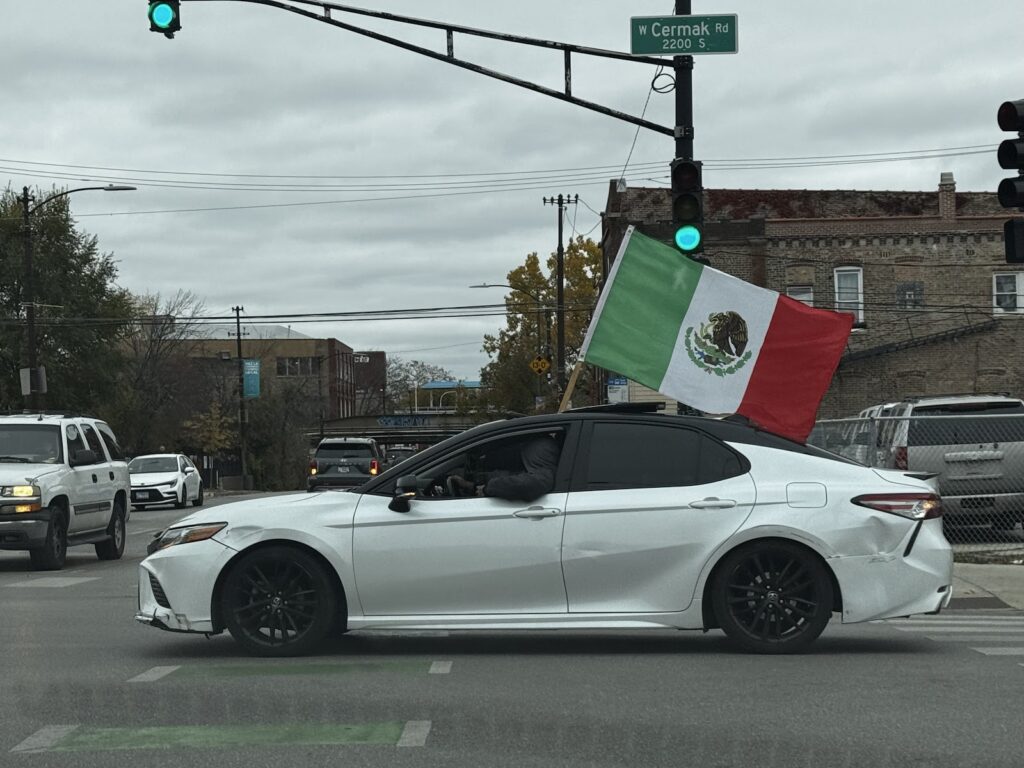
As Guerrero headed back to Daisy by West Cermak Road and South Kedzie Avenue, vehicles blasted Mexican corridos, stories told through traditional folk ballads, held the Mexican flag out their windows and released cries, known as El Grito. Westbound from Cermak, a confrontation between ICE troops and citizens took place, lasting around 15 minutes.
El Capiro De Sinaloa, a Little Village celebrity, rode his bike while holding the Mexican flag; children played with colorful whistles and organizations canvassed in between intersections. Guerrero spoke to several locals about the confrontations he witnessed throughout the day.
“This reminds me of 2020,” said Guerrero, reflecting on the four-hour expedition as he drove back towards Pilsen.
Wearing a black baseball cap adorned in a red bandana with yellow butterflies stating “No One Is Illegal,” a denim Chicago Bulls bomber jacket and black skinny jeans, Guerrero was exhausted, non-verbal and dehydrated. Tapping the steering wheel with green and white checkerboard nails, the self-proclaimed community helper is winding down on an empty stomach.
After a quick pitstop at his Pilsen office, Guerrero headed towards the Pilsen Arts & Community House to perform a live DJ set for artist Fabiola Rivera’s solo showcase “Yo Sueño Aquí: Arte Y Resilencia.” ICE updates infiltrated his phone nonstop, but Guerrero is focused on the main task at hand: Neighborhood bonding.
The taste of blood in his mouth, the sight of a youth football game at Harrison Park and the relief of finding the perfect street parking spot. Guerrero was back in his hometown, grabbed his DJ controller and put a smile on his face as he walked into the space.
A piece of jalapeno and cream cheese-filled bread from Panaderia Nuevo Leon fueled Guerrero, and he was ready to go. As his phone continues to flash with ICE notifications, Guerrero is mixing reggaeton classics while visitors of the art exhibition talk, discuss and learn about Rivera’s work.
Alexander Hernandez Gonzalez is a rising fourth-year student at Northwestern University, double-majoring in Journalism and Latina/o Studies with a minor in Political Science. His work has been published under L’OFFICIEL USA, CR Fashion Book, Denver Westword, The Daily Northwestern, STITCH Magazine, Gente Fina, Desperado and North by Northwestern.