
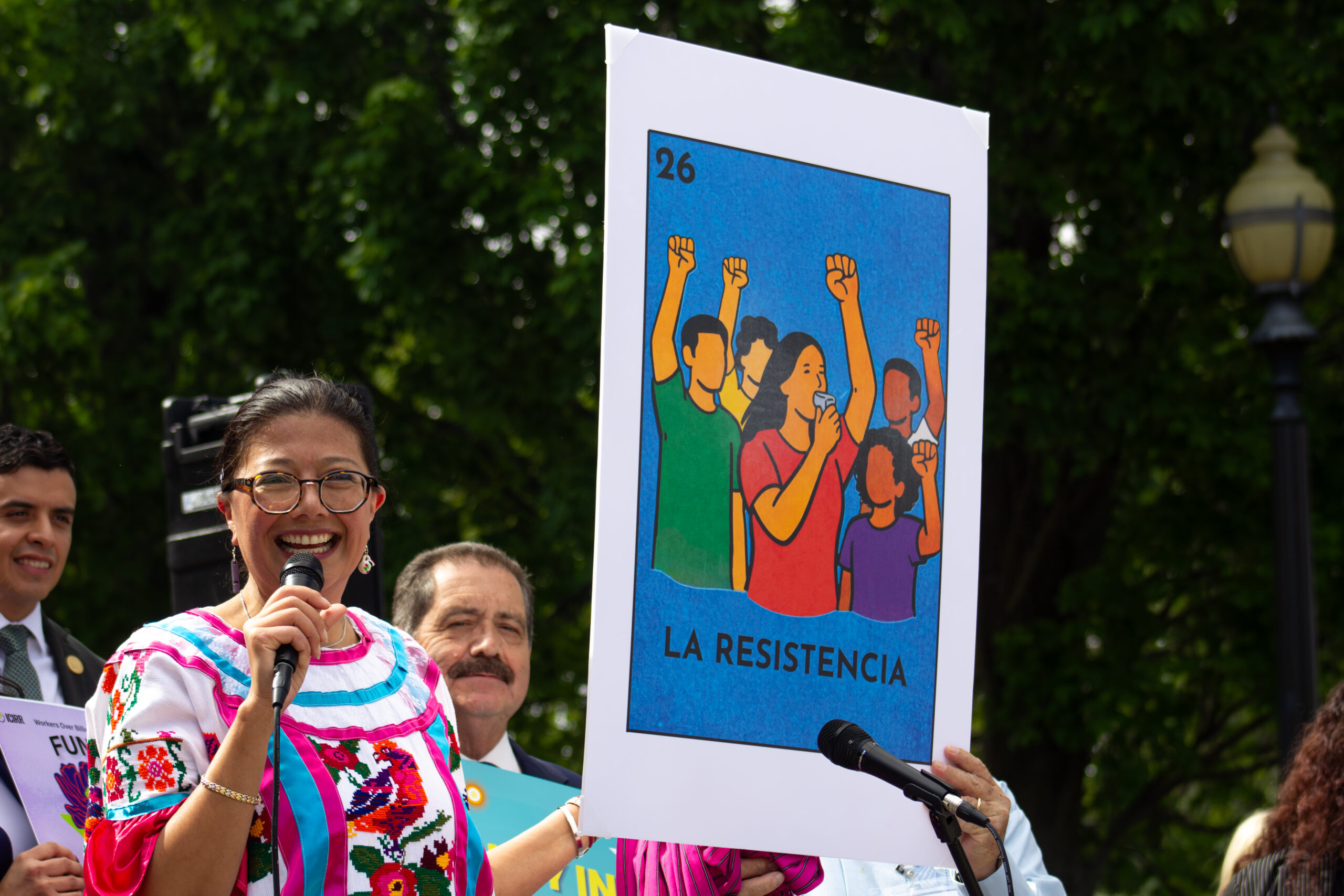
Latino community leaders and residents from across Illinois gathered in Springfield earlier this month for the 16th annual Latino Unity Day, a two-day event that turns advocacy into a unified push — bringing community members face-to-face with lawmakers on topics directly affecting the Hispanic/Latino community.
“[Latino Unity Day] isn’t just a conference,” said event founder Layla Suleiman Gonzales. “This is a very intentional opportunity to harness that collective power and allow leaders to kind of replenish their energy, to be able to continue fighting for justice.”
Latino Unity Day is the state’s largest “civic‑engagement advocacy event for the Latino community,” according to Jose Marco‑Paredes of the Latino Policy Forum, which organizes the gathering. Since 2010, the event has brought Latino leaders, community members, and allies to the Capitol to meet directly with elected officials and learn how legislation is shaped, developed and passed.
This year’s agenda included panels on Latino representation in state government, access to higher education, community workshops, and a rally in front of the Capitol on the final day.
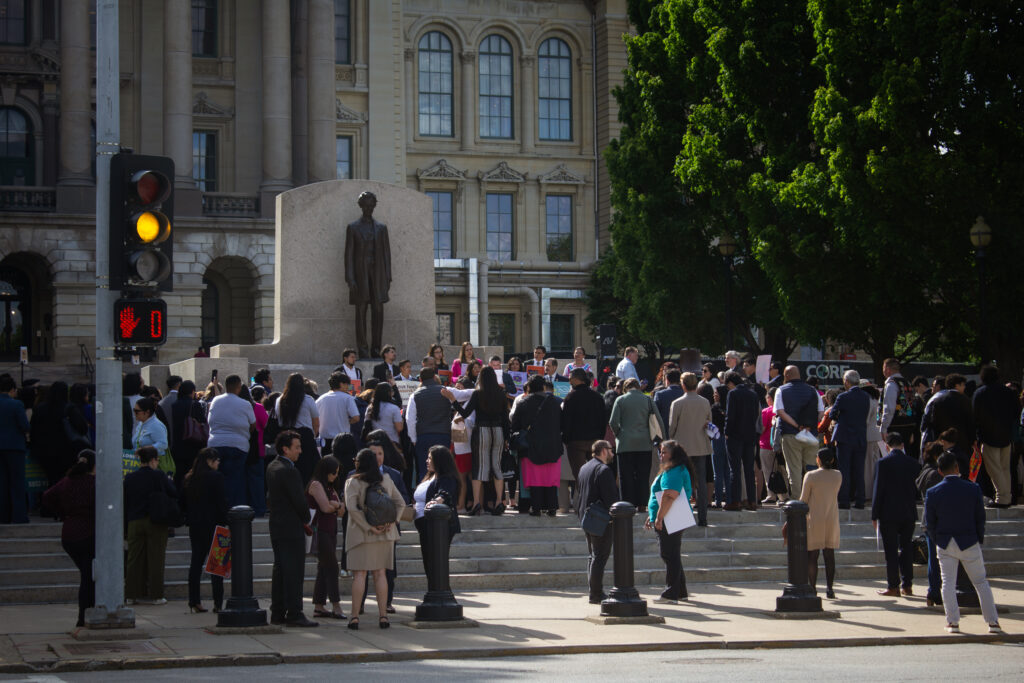
Crowd gathers for Latino Unity Day. (Britton Struthers-Lugo/Latino News Network)
“It’s just been amazing to see how Latino Unity Day not only has grown in terms of the collective power of the community,” said Suleiman Gonzales, the event’s founder. “But it also has extended far and wide and brought so many people that may never have had an opportunity to go and meet with their legislators or even come to the capital, or come to understand how legislation gets shaped, developed, and passed.”
Suleiman Gonzales explained that Latino Unity Day was built on the advocacy work being done independently by state organizations, such as the Association of Hispanic State Employees and the Hispanic Illinois State Law Enforcement Association. As the Latino population in Illinois grew in the early 2000s, she said there was a greater need to bring together these organizations at a more unified event, giving people the chance to become better educated and more active in the legislative process, and to shape the year’s legislative priorities.
“It’s not a generic civic participation,” said Suleiman Gonzales. “It’s very much geared towards how we become active in creating the policies and the legislation and the law that is adopted by the state that then impacts our everyday lives.”
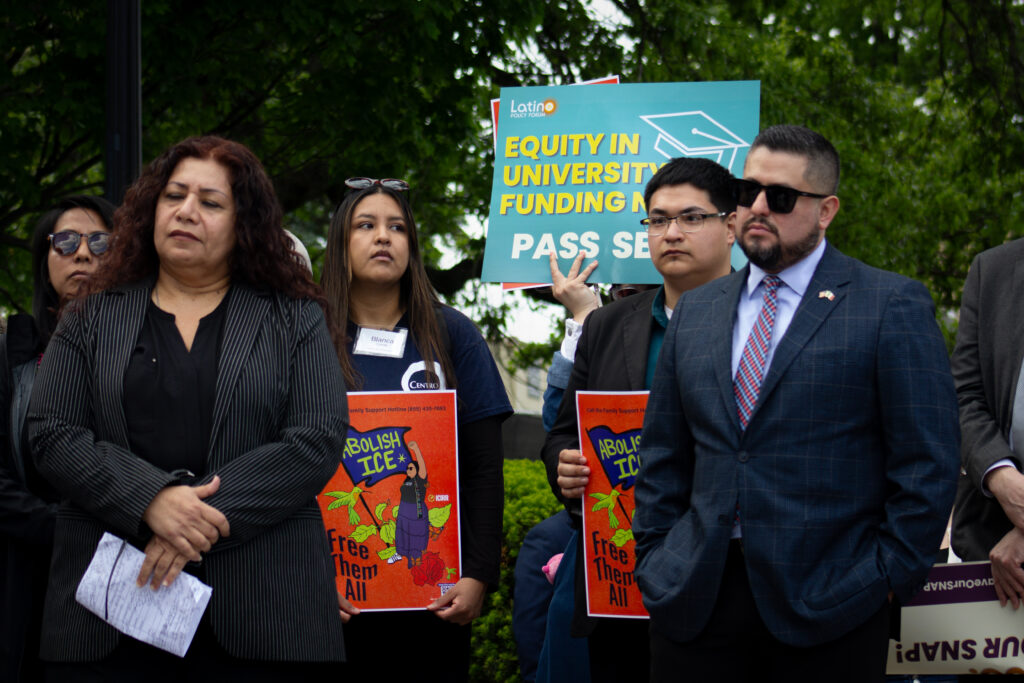
Poster for equity in university/schooling. (Britton Struthers-Lugo/Latino News Network)
Now a two-day event, participants spend the first day attending panels to learn about issues affecting the Hispanic and Latino community in Illinois – such as healthcare, immigration, and higher education – and what bills related to those topics are on the table during that year’s legislative session. Additionally, the event began and continues to serve as an annual push for Latino representation in the Illinois state government.
“What we try to do is elevate the importance of having Latino representation in state government to better serve the Latino community,” said Carlos Charneco, a former state employee of 38 years who currently volunteers to organize Latino Unity Day.
According to interviews with organizers and participants, the event’s effectiveness comes from its structure: participants receive issue‑specific training before meeting legislators and pairing participants with a policy expert who helps translate community concerns into legislative language.
“We have to have more Latinos, both in the front line and middle management and at the very top, to make sure that we have a voice in state government,” said Charneco.
The Mechanics of Being Heard
One bill folks advocated for at this year’s event was Senate Bill 0013, which focuses on increasing support for Latinos seeking higher education. The Adequate and Equitable Public University Funding Act would improve financial support for public universities in Illinois, making higher education more affordable for more Latinos, as tuition rates continue to increase each year.
Resources that help Latino and immigrant students graduate from public universities have decreased since the early 2000s, according to the Latino Policy Forum. Additionally, research from the Latino Policy and Politics Institute found that only 17 percent of Illinois Latinas and 13 percent of Illinois Latinos hold a bachelor’s degree – both slightly lower than the national average for Latinos.
Attendees also highlighted Senate Bill 3167, which addresses how the recent cuts to Supplemental Nutrition Assistance Program (SNAP) benefits affect “humanitarian immigrants,” who are foreign nationals that enter or remain in the U.S. to escape danger, persecution, natural disasters, or severe hardships.
Due to new federal requirements imposed earlier this month, approximately 120,000 Illinois residents are at risk of losing their SNAP benefits. According to 2023 data from the Pew Research Center, 24.2 percent of United States adult SNAP recipients and 40.7 percent of U.S. child SNAP recipients are Hispanic. Roberto Valdez, the Midwest regional director for the Hispanic Federation, said cuts are expected to hit the Illinois Latino community hard, making bills to blunt those reductions a key focus of this year’s event.
“Latino Unity Day is an opportunity to elevate these bills right, and remind our legislators that they’re not just pieces of legislation,” Valdez said. “These are people’s health and food security on the line.”
Without Illinois legislators also championing these causes to move forward, there is not much left for the general public to do. Latino Unity Day focuses primarily on advancing representation in state government and gives allies and the Illinois Latino community an opportunity to meet with legislators to discuss concerns important to them. Without Latino and Hispanic representation, elected officials might not advocate as strongly for policies that would benefit those communities.
“Events like Latino Unity Day encourage elected officials to connect with their residents while giving residents an up-close look at the work we are doing for them,” Illinois Attorney General Kwame Raoul wrote in an email to the Latino News Network. “I had the honor to personally connect many representatives within the Latino community, to hear their stories and concerns. Those conversations are what motivate me to keep pushing back on unlawful orders and disproportionate treatment of our most vulnerable residents.”
No Voice Without a Seat
The state’s government has different caucuses – the Illinois Legislative Black Caucus, the Latino Caucus, and the Asian American Caucus – all dedicated to advancing and developing their respective communities across Illinois. After identifying a lack of Latino representation within the Illinois state government, four legislators founded the Illinois Legislative Latino Caucus Foundation in 2002, explained the foundation’s current executive director, Oswaldo Alvarez. The foundation serves as the Latino Caucus’s non-profit arm that is meant to provide the caucus with the necessary tools for effective public policy.
Since 2002, the foundation has grown from a handful of legislators to 18 Latino senators and representatives serving Illinois communities.
“We are the ones who build a lot of the public policy that the Latino Caucus then pushes whenever they are in session,” said Alvarez. “So every year our mission is to foster the next generation of Latino leadership, and to advocate for the needs and wants of the community.”
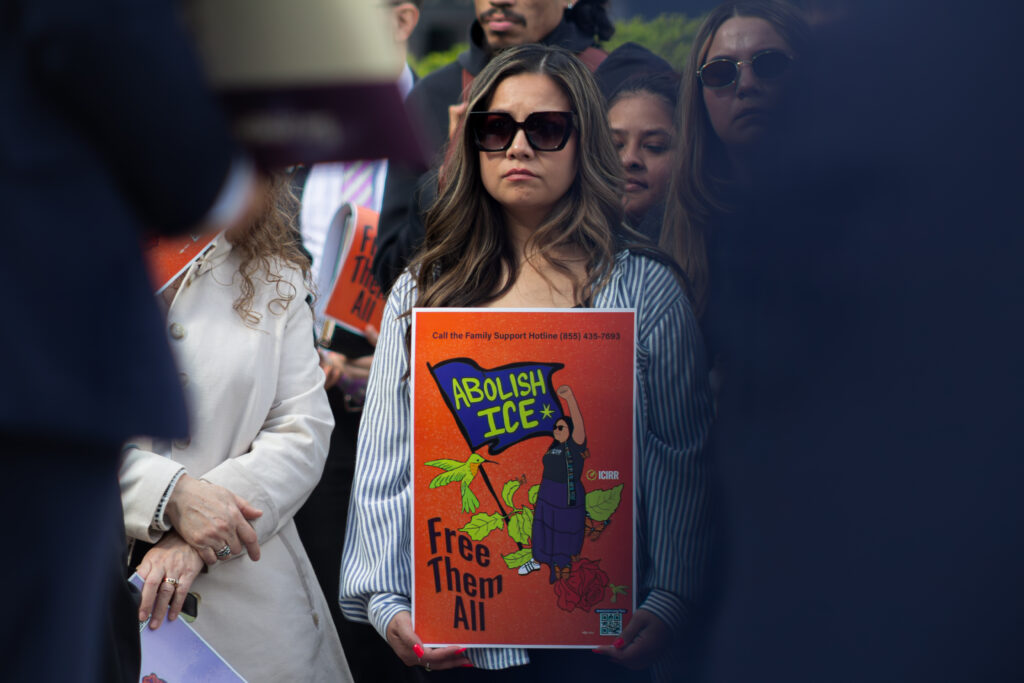
Attendee at Latino Unity Day holds an “Abolish ICE” poster. (Britton Struthers-Lugo/Latino News Network)
The Latino Caucus has also seen success since its founding.
With the support of the caucus and advocacy from Latino Unity Day participants, Gov. Pritzker signed the Temp Worker Fairness and Safety Act into law in 2023. It took approximately six months for the bill to be introduced and signed. Suleiman Gonzales said that because Latino Unity Day educates attendees on the realities of the legislative process, they are more likely to return each year to fight for solutions to become bills, and for those bills to become law.
“Change in government is always slow,” said Charneco. “It’s not something that happens overnight. Some bills die, and then you try to resurrect them the next year. So this is a continuation of pushing and having those voices heard.”
Despite its successes, the model has limits.
The first Latino Unity Day saw 65 people attend to learn about issues affecting Illinois Hispanic and Latino communities and to meet with legislators later that day. Event attendance grew to 900 last year and dwindled to around 600 this year. Suleiman Gonzales said she believes the lingering fear and apprehension surrounding ICE caused this decrease.
While the event draws highly engaged participants, it still remains challenging to reach residents who face the greatest barriers to civic participation, including those who may feel unsafe engaging with state institutions.
Sen. Karina Villa (D-Elgin) attended the rally on the second day of the event to address the crowd and unveil that year’s poster-sized, custom lotería card – a Latino Unity Day tradition; this year’s card was “La Resistencia,” referencing the mutual aid and rapid response groups who played an integral role in protecting residents from ICE.
“I am so happy to be here,” said Villa to the crowd in Spanish. “We will dedicate today to the rapid responders. We will dedicate it to every individual who, instead of staying inside their house, … decided that their neighbors were more important than what was happening in the White House.”
Although the bills and specific legislation the group advocates for change from year to year, the broader themes of supporting Latino communities and celebrating Latino culture will continue each year at Latino Unity Day.
This report is part of the Healing Illinois 2026 Reporting Project: Democracy Lives Here, led by the Medill Solutions Journalism Hub and funded by Healing Illinois — a racial and community healing initiative from the Illinois Department of Human Services in partnership with the Field Foundation.
As part of this project, ILLN is leading bilingual, statewide reporting examining how Latino communities across Illinois are shaping democracy during the nation’s 250th anniversary and ahead of the 2026 midterm elections.
This article was edited by Latino News Network Publisher, Hugo Balta and Latino News Network Midwest Managing Editor, Angeles Ponpa.
Cover Photo: Unveiling the loteria card // theme of Latino Unity Day (Resistencia) (Britton Struthers-Lugo/Latino News Network)