
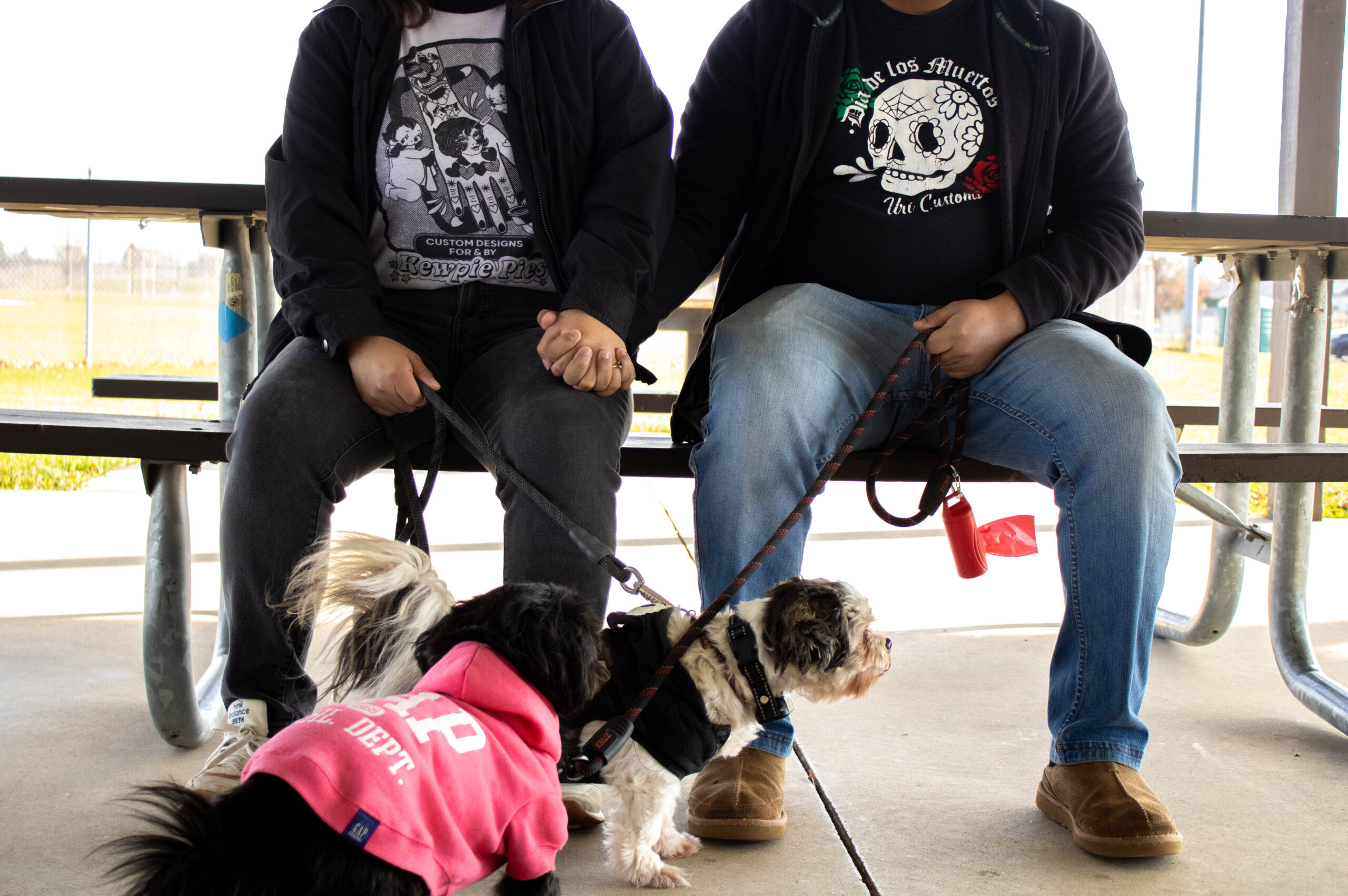
CHICAGO – The late July heat beat down on the park where Jessica and her family celebrated a birthday party for her grandmother. Her grandmother had flown from Mexico on a tourist visa that took four years to get. Jessica was enjoying time with her family and dogs, looking forward to the mariachi band that would be arriving any moment.
Her mom came over and told Jessica that she noticed her dog Kirby’s name tag on the floor, confusing Jessica. She checked around Kirby’s neck and saw a new tag that read “Jess & Ruben” on the front, and “Will you marry me?” on the back.
“As soon as I was done reading her tags, the mariachi band started playing behind me,” said Jessica. I turned around and there he was, Ruben having one knee down with the ring case open.”
There wasn’t any rush to have the wedding.The original plan was to wait two years to save money and enjoy engaged life. But increased ICE activity around Madison and Chicago – where Jessica and her fiancé’s families live – changed that. They now feel like the only choice is to wait out the Trump administration, putting their wedding on hold for the next four years.
“It was such a big deal to have my grandma involved, and I of course want her to come to our wedding,” said Jessica. “It’s just … I don’t want ICE to detain her, and she doesn’t speak any English, so she would be completely lost. Or the fact, if ICE detains my mom, she wouldn’t know what to do, and I just don’t want to put that stress on my grandma, especially when she is so frail.”
Since Trump took office in January, the prevalence of ICE and detainment of undocumented immigrants and U.S. citizens have significantly increased. Many Latinos now feel like they need to stay hidden and not attract attention to themselves out of fear of being targeted – regardless of immigration status.
“I should be practicing my First Amendment right to speak out on things,” said Jessica. “But I just feel so restricted. I just can’t speak out.”
Cindy Eigler, executive director for the Coalition for Immigrant Mental Health, said her team has seen and heard about children who are worried about being racially profiled, to adults who now have their U.S. citizen friends or kids go to get groceries for them.
“I think it’s across communities, across generations, that everyone’s experiencing this [fear],” said Eigler. “We’re getting requests from the schools of how they can support the children who are experiencing a lot of anxiety, who are really scared that nobody’s going to be able to pick them up or be there to pick them up if their parents get taken during the day.”
Individuals from and serving immigrant communities in Illinois founded the Coalition for Immigrant Mental Health after the 2016 election. Some of their work includes building collective capacity and a strong sense of community. Clinicians hold weekly open spaces where people who are impacted by ICE can process their experiences.
“Right now, people are not feeling safe given the increased enforcement,” said Eigler. “People are not feeling connected, given the isolation, and people are not feeling a level of belonging, given all the anti-immigrant rhetoric that is so prevalent right now.”
This isolation has also affected the way many Latinos navigate once safe spaces, such as celebrations and gatherings.
Woodstock, Illinois, held its ninth annual Mexican Independence Day celebration on Sept. 14. The sound of live music and smell of authentic Mexican food filled the air. Caballeros rode around the downtown area, and women adorned traditional Mexican dresses.
The major difference between this year’s event and previous ones was the diminished crowd size.
“Not as many people turned out for it, because we don’t want to draw attention to ourselves,” said Marilyn, a McHenry County resident.
Other folks who attended the celebration also described the crowd as smaller and less vibrant than in past years. They credited this to the possibility that ICE might target those in attendance.
Like Marilyn, some attendees felt the celebration was a “bright spot” at a time when videos of Latinos being violently detained by ICE agents highlighted the reality that those in the community faced. For others, the thought of attending an event that could be easily targeted by ICE kept them home.
“It was very sad, because it’s something that I’ve attended in the past,” said Lourdes*, a Chicago resident using a pseudonym because she is an undocumented immigrant (in fear of deportation if she gives her identity).
“It’s a celebration, and it’s a really great opportunity for community, but it’s been one of many celebrations or outings that I have decided not to go to just to avoid the potential of experiencing some life altering or very traumatizing experience,” she continued.
Latinos have avoided attending other large gatherings meant to celebrate each other and their culture. Juan, another McHenry County resident, was in charge of coordinating attendance for his sister’s quinceñera party this year and received multiple declined invitations.
“I had a lot of family in California that, as a result of fear, couldn’t attend,” said Juan. “I think it was upwards of like 30 members of my family couldn’t attend.”
The party provided a moment of normalcy for Juan and those in attendance to feel isolated from the state of the U.S. and focus on celebrating his sister.“It’s been a big bummer,” said Juan. “I haven’t been able to see some people that I really love seeing. And, if I do see them, it’s not in any large capacity, it has to be sort of in a home, which is nice, but it’s just kind of a sad state of affairs.”
Juan added that while he tries to be loud and boisterous about his Latino pride, it is disheartening to watch his community’s light dim.
“It hurts a lot, because these are some of the hardest working people I know,” said Juan. “A lot of them are even super patriotic; they’ve come to love the United States. It sucks that I have to watch my community suffer, and especially one that has so much joy in life attached to it.”
This loss of joy and increased apprehension has also affected the ways in which many Latinos express themselves.
Lourdes said she feels nervous playing Mexican music in her car and often avoids wearing traditional Mexican jewelry or clothing to keep from drawing attention to herself. She added that although she is white-passing, every day still feels like living in a nightmare.
“I am undocumented, so, for me, this has been psychological warfare,” said Lourdes. “It has been very intense, and it’s a battle that I’m fighting every single day to still do the things that I can and should be doing, like attending my classes, still getting together with friends, basically maintaining a normal life.”
Eigler described how the trauma from ICE impacts not only the physical and mental health of folks in and serving immigrant communities, but also their ability to feel guilt-free joy and connection.
“People feel a level of guilt for even thinking about experiencing joy or happiness, or prioritizing or making space for that, given how much harm is happening and threat is happening in our communities right now,” said Eigler.
Reported ICE sightings across communities have made Latinos feel like agents could be anywhere. Jessica and Marilyn described how this panopticon-like threat has made them feel like they need to suppress their identities.
“I am still very proud to be a Latina,” Jessica said. “It’s just the fact that sometimes I am afraid to say it out loud in public due to the judgment I may face. I’m actually afraid to post stuff on social media and spread the word how ICE is damaging this country, only because I know people are so nasty online, and they could just easily look up my information, they can find my family, and that’s my biggest fear.”
Because Thanksgiving and Christmas gatherings tend to be smaller and more intimate, there is less fear for safety during the holidays. Lourdes said she looks forward to trying to replicate a sense of normalcy through practicing ritualistic moments with her family, such as preparing food and spending time together.
“This is the most low-risk kind of gathering that we can have, because it’s in the comfort of our own home,” said Lourdes. “It’s also just like resisting, not letting [ICE] get in the way of us having the joy of getting the family together. But, nonetheless, they are in the back of everybody’s mind.”
Editor’s Note: Illinois Latino News granted anonymity to sources due to concerns about retaliation, immigration enforcement and personal safety. Their identities are known to the newsroom.
McKenna Sweet is a recent University of Washington graduate and current freelance journalist who primarily writes science and community pieces.
Photo credit: McKenna Sweet