
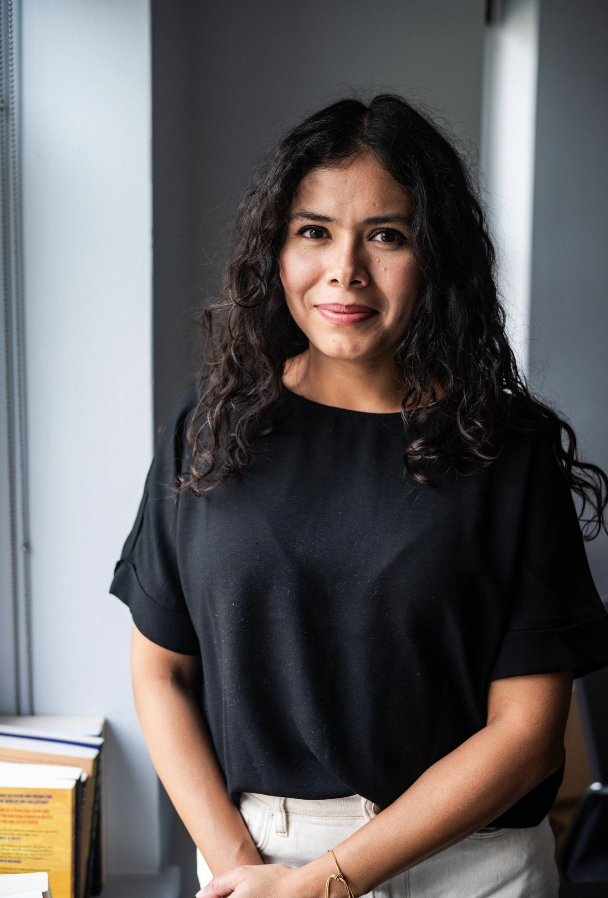
Francia García Hernández is a reporter at Block Club Chicago. She covers various neighborhoods, including Pilsen, Little Village and Back of the Yards. She is also a host, writer and co-producer of CAN TV’s show, “¡Presente!,” which focuses on Latino voices.
García Hernández earned a degree in social responsibility and sustainable development from Universidad Anahuac Mexico Norte and began her career in Mexico. She moved to Chicago when she was 25 and received her masters degree in civic media at Columbia College Chicago.
Before working as a freelance journalist in Chicago, she worked on strategic communication and social responsibility programs for LSC Communications Mexico, Tercer Impulso A.C., Nestlé Mexico and Mercado el 100.
Now, her bilingual education in Mexico is intertwined with her journalistic interests in Chicago.
García Hernández speaks to Latino News Network about her career and how she has used Spanish to transcend boundaries.
What led you to choose your career path?
I never thought I would become a reporter. It isn’t something I dreamed of, but whenever I think about how I got here, I realize the news and journalism always had an influence on me. My grandfather was one of those people who read the newspaper every day. And not just one, but several, in order to get different perspectives and opinions. My family has always been one that watches the news every day or stays informed… And now that it’s my job, I try to do the same for others.
How did you learn English?
I learned English from kindergarten in Mexico at a bilingual school and took English classes from kindergarten through high school.
What importance does language have in your day-to-day work?
The ability to speak Spanish is very important. For my job, I cover communities that are mainly Latinos or that have Latino influence in Chicago, like Pilsen, like Little Village, Back of the Yards or Las Empacadoras, Midway, Brighton Park, and there are people who feel more comfortable speaking Spanish. There are some that don’t speak English or don’t speak it very well. And I think that language is not just a tool to communicate — it also has cultural aspects that you can identify with or that allow you to understand the cultural, social or economic context of the people you are interviewing. That gives the coverage another dimension.
Why is it important to have bilingual journalists in the United States?
If there aren’t bilingual reporters, it is impossible to understand and know exactly what is happening in these types of communities, and that news can get lost. There would be no local coverage.
Was there ever a moment when talking to someone in Spanish you learned something you wouldn’t have learned if you had only spoken English?
Last year, I covered the new immigrants that arrived here in Chicago from Central and South America, and many of them arrived recently and did not speak English. So we would not have been able to do this reporting if we did not speak Spanish.
I know your series with CAN TV, called “¡Presente!,” is very focused on Latinos. Can you tell me a bit about how you produce this series?
CAN TV proposed this project and, with the CAN TV team, the producer Hugo Balta and I, we have found themes that are relevant to the Spanish-speaking community here in Chicago. And each episode is focused on a specific theme. For example, in one episode, we spoke about the economic impact of immigrants in the area. And after that, we chose to do a segment directly in the community with people or representatives from that sector or the topic we are discussing who are relevant so that they can talk a little about their experience, their stories, what they have learned and their challenges. And later we have a panel of experts who also discuss these issues from their perspective. So we cover different topics, but the idea is to elevate Latino and local voices in order to share their experiences.
The series is in English, but have there been participants who only speak Spanish?
The majority of guests speak as much English as they do Spanish. So the program has been in English, but we have always given people the freedom to use Spanish if they prefer to do so, or if there are words that don’t have a perfect translation in English. It would be like a mixture of Spanish, which is also very common among many people who have Hispanic origins, but grew up here.
How can the city of Chicago improve bilingual representation in Latino communities?
I believe there are many interesting proposals for local journalism in which the people from these communities, who speak two languages, who know their community, who understand the challenges their neighbors face and their culture and context, can contribute their grain of sand, their stories. They can share what they believe is not being represented in the media, and they can be part of the media in one way or another, so that there is more representation.
Ruby Grisin is a student at Northwestern University whose work has appeared in The Louisville Courier Journal, The Daily Northwestern, UPI, Midstory and others.
Publisher’s Notes: The interview has been lightly edited for clarity. The conversation, originally held in Spanish, has been translated to English.
This story, among others, was produced by undergraduate students in the bilingual reporting class at Northwestern University’s Medill School of Journalism, Media & Integrated Marketing Communications. Led by Prof. Mei-Ling Hopgood, the class aims to help journalism students practice sensitive and ethical engagement and reporting with multicultural communities in Spanish and English.
Cover Photo: Courtesy of Colin Boyle, director of photography at Block Club Chicago.